

Apr 10, 2011
Registry editor (Regedit) settings for notepad++ context menu.
Settings:
A] To Visible/Invisible Icon in context menu -
1] go to HKEY_CLASSES_ROOT\CLSID\{00F3C2EC-A6EE-11DE-A03A-EF8F55D89593}\Settings
2] modify ShowIcon value to 0 (zero) for invisible and 1 for visible.
B] To modify context text
1] go to HKEY_CLASSES_ROOT\CLSID\{00F3C2EC-A6EE-11DE-A03A-EF8F55D89593}\Settings
2] modify Title value to text you want (e.g. - edit with npp++)
Download application for this settings
Download
Jan 10, 2011
Just few minutes back while I was playing with registry, found some tricky values for notepad++ shell extension (context menu icon and title).
Then wrote little application to modify them.
Download : Zip

Registry settings for this will post later..
Oct 29, 2010

First Open Registry editor
Steps:
1] go to 'HKEY_CLASSES_ROOT\CLSID\{87D62D94-71B3-4b9a-9489-5FE6850DC73E}\InProcServer32'
2] set default value to '%SystemRoot%\system32\shmedia.dll'
3] Restart your pc and its done..
:)
[XP only]
Oct 27, 2008
When AutoPlay is activated n our Data CD/DVD or flash drives inserted, Windows will execute an Applications which is configured in autorun.inf. Read Wiki for more information of Autorun.inf
Mostly all viruses travels from autorun to system directory or drive
Here ill tell you how to block specific files from autoplay instead of Disabling Autoplay system.
Settings:
1] Run > regedit
2] go to HKEY_LOCAL_MACHINE\SOFTWARE\Microsoft\Windows\CurrentVersion\Explorer\AutoplayHandlers\CancelAutoplay\Files
3] Add New String value and name it with application name which you want to block.
4] e.g.- Some bad coders use shell32.exe (system contains shell32.dll, see the difference between .exe n .dll) to execute virus from autorun.inf
[note:- shell32.exe, run32.exe, ntdetect1.exe these used to run virus cause system contains this named dll]
5] so to block shell32.exe from autorun i'll add new string value - name 'shell32.exe'
6] to block any other applications which contains 32.exe, so ill add '*32.exe'
7] you can block any file formats, e.g- vb scripts like 'killtask.vbs'
8] or you can set '*fun*' something like for blocking fun.exe
9] read by default string names to better understand..
Done. :)
Oct 16, 2008
Two days ago i wrote another program for adding my favorite folder at drives context menu in My Computer.
This application allows you to add your favorite or working folder to drives context menu..
You can Set/Update/Remove this context menu easily using this application..
Useful for lazy people like me :)

Download:
AddContextDrive.zip (mirror1)
Oct 8, 2008
Most of all viruses first blocks your Registry and Task Manager, So you can not remove viruses manually from start up and also you can not kill running virus process, so you need to Enable Task manager and Registry to kill process and remove from start up..
Last night i just wrote this little application for my handy use when playing with virus, hope its useful for everyone :)
This application is allows you to Enable/Disable your registry Editor, and also allows you to Enable/Disable your Task Manager (User/admin)..
Download:
Download (mirror1)
Sep 30, 2008
Last night i wrote an application to remove files context menu and Property tab of Quick Heal scan..
Last month I'd post about registry settings of quick heal context menu and property tab, n by using this hacks i wrote this application to easily enable and disable the context menus n property tabs
Features:
1] Disable / Enable Quick Heal context menu of files
2] Disable / Enable Quick Heal context menu of folders and drives
3] Disable / Enable Quick Heal property tab of files
Download this by using below links:
1] Download - Mirror 1
For uninstall Quick Heal read this post
Sep 18, 2008
This setting allows you to Remove 'sendto' option from right-click menu (context menu).
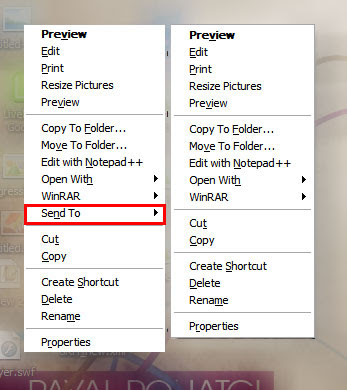
1] Run > Regedit > hit Enter
2] Registry > My Computer > HKEY_CLASSES_ROOT > select AllFilesystemObjects
3] AllFilesystemObjects > shellex > ContextMenuHandlers
4] ContextMenuHandlers > select Send To
5] now right side pane double click on '(Default)'
6] Add '-' (minus sign) in front of {7BA4C740-9E81-11CF-99D3-00AA004AE837}
7] like this ' -{7BA4C740-9E81-11CF-99D3-00AA004AE837}'
8] Now refresh your Desktop n check right click menu.. :)
Sep 11, 2008

This registry setting allows you to add a new file extension and file type that is currently not not available in your windows system, and adds inside your right click 'New' context menu .
Many time we needs a file to store our personal data, notes, reminders, appointments etc.. n which wants to identify easily in our system files..
By using this setting you can make your own file type n extension for your daily use :)
Settings:
(Dont use single or double quotes in complete setting)
1] Start > Run > regedit> hit Enter
2] Select HKEY_CLASSES_ROOT key..
3] Right Click> New > Key (add New key at HKEY_CLASSES_ROOT)
4] Write your file extension like '.note' ( or any other which you want, but use dot "." before extension, i used .note )
5] on right side pane double click on (Default) to modify '(Default)' value to file write as 'notefile'
(Do not use any spaces between file type value, you can use any other value too like myfile, mynotes so on..)
You just added file extension, now you need to set data for your file type..
6] Now go back to HKEY_CLASSES_ROOT key..
7] Create New Key by right click
8] write 'notefile' as key name ( we used 'notefile' is file type for our extension, which is same as where we set step 5, if you used any other file type write this same value as your key name)
9] On right side pane, double click on '(Default)' n set description for your file Like 'My note file'
( here you can use spaces)
10] then right click in blank space at right side pane n add new DWORD value, write 'BrowserFlags' as name, double click on BrowserFlags to modify n set Hexadecimal value '8' (Eight)
11] add another new DWORD value, name it 'EditFlags' n set Hexadecimal value '0' (Zero)
12] Select 'notefile' > add new Key > write key name - 'DefaultIcon'
13] on right side pane double click on '(Default)' n write path of your icon file for your extension
like 'C:\WINDOWS\myicon.ico'
14] Select notefile key, add new Key n name it 'shell'
15] Select shell Key, add new Key n name it 'Open'
16] Select Open key, add new key n name it 'command'
now you are here- 'HKEY_CLASSES_ROOT\notefile\shell\Open\command', ok?
17] Now on right side pane select '(Default)', double click to modify, n now right the path of application for your file type, like 'C:\WINDOWS\notepad.exe %1'
18] Now we want to add our file type inside right click New menu so go back at '.note' key
19] select '.note' key, add new Key n name it 'ShellNew'
20] On right side pane, right click in blank space n add new String value, name it 'NullFile'
(Dont set any value for this Nullfile, leave blank)
See image [Or Download this registry file for setting, n change the icon path in reg file, rename this file as 'filetype.reg' by removing .txt of file, and merge it)
Sep 1, 2008
Last week i got new hack to change the position for open with and winRAR context menu..
I just added single DWORD value in CLSID of open with n winRAR and it works perfect in a single try..
So i like it share with you..

Lets start..
follow my few steps and change your context menu position...
Settings:-
1] Start > Run > regedit> hit Enter
2] Registry > HKEY_CLASSES_ROOT > go to 'CLSID' key
for Open with..
3] CLSID > find & select {09799AFB-AD67-11d1-ABCD-00C04FC30936}
(to find press ctrl+F, look at only keys)
4] On right side pane you will see '(Default)' string value like 'Open With Context Menu Handler'
means your at right key
5] Right click in right side pane > add New > DWORD value
6] Name it as 'flags' > hit enter to save
7] Double click on flags to modify> set Hexadecimal value '1' (one)
8] Now refresh your desktop n check context menu
for WinRAR...
3] CLSID > find & select {B41DB860-8EE4-11D2-9906-E49FADC173CA}
4] Right click in right side pane > add New > DWORD value
6] Name it as 'flags' > hit enter to save
7] Double click on flags to modify> set Hexadecimal value '1' (one)
Remember:
1] if you set flags to '0' (zero) - Your selected context menu will be display under Rename menu
2] if you set flags to '1' (one) - Your selected context menu will be display with sendTo, copy to folder n move to folder (like in image)
3] if you set flags to '2' (two) - It display at default position
Aug 17, 2008
Who mostly uses a photoshop to editing images, if they want to open an image file then they use file > open from photoshop menus..
Me 2 mostly use photoshop for editing images but im lazy to open every image from photoshop's open menu, so i edit some keys in my most favorite registry editor to add context menu for open jpg/jpeg to photoshop directly....
and made my context menu something like below image.. look it...

Now im giving you settings for this hack...
1] Start > Run > regedit> hit Enter
2] Registry > My Computer > HKEY_CLASSES_ROOT > jpegfile
(if you not found this key then Find it from edit> Find> n tick to key only)
4] Then name this new key as 'Open in CS2' or something like you want to set
5] Select 'Open in CS2' > add New Key again > name it 'command' (case sensitive)
6] select '(Default)' from right side pane > Double click to modify value
7] enter value as [ C:\program files\Adobe\Adobe Photoshop CS2\photoshop.exe "%1" ]
(means - your photoshop application path and "%1" with quotes )
8] refesh desktop n check any jpg/jpeg image files context menu
Download jpg-cs2.reg.txt file , rename this txt file as 'jpg-cs2.reg' and merge it..
Update: 01.Feb.09
Download Application to set Open with context menu for images
Aug 16, 2008

In windows, we open some files with other supported applications too.. like mp3 files we can open with winamp, media player, itune, or many other mp3 players...
Now here ill tell you hack for how to remove unwanted applications from this open with list..
This is very simple n useful trick
lets go..
Settings:-
1] Run > regedit > hit Enter
2] Registry > My Computer > HKEY_CLASSES_ROOT > Applications
3] When you expand 'Applications' key then you will see a long sub keys list of program names
like accwiz.exe, BitTorrent.exe, n something like more list..
4] Then select a application key which you want to remove from 'Open with' list..
(e.g.- i selected 'flash.exe' to remove from list)
5] Right click in right side pane in blank area or go to Edit> New
6] add New> 'String Value' (REG_SZ)
7] Change name of string value as 'NoOpenWith' (case-sensitive)
8] We Don't need to set any value data for this string..
9] Refresh your desktop n check open with list for any file..
Finish... :-)
Aug 14, 2008

When we install 'Quick heal' anti virus then it also adds a property tab for every file to show is it infected or not...
This tab is graphical tab so it takes little bit time to load.. so we never use this tab.. so i got hack to remove this tab easily..
This setting removes this tab and makes your property window loads faster....
Settings :-
1] Run > regedit > hit Enter
2] Registry > My Computer > HKEY_CLASSES_ROOT > select * (1st subkey)
3] * > shellex > PropertySheetHandlers >
{9ECB3F62-A9BC-4ff1-8E26-4F8BA5363190}
4] select '{9ECB3F62-A9BC-4ff1-8E26-4F8BA5363190}' > Right click > Rename or Press 'F2' on keyboard to rename key
5] add ' - ' (minus sign) in front of this key ( before curly braces)
6] Now your key is like '-{9ECB3F62-A9BC-4ff1-8E26-4F8BA5363190}'
7] Hit Enter
8] refresh your desktop or my computer, and check ur property window for any single file
That's Done,
Good luck
:-)
Aug 13, 2008
 When we install 'Quick heal' then it display 'Total Security Scan' menu in our right click context menu for all files, folders, n drives and it also shows a lens icon front of menu, we often use this context menu.
we mostly use this context menu for flash/pen drives, CD/DVD's to check viruses.
This setting allows you to remove this 'Total Security Scan' menu form right click context menu for any file and any folder, this is very simple trick for registry hack..
Settings:
For any file:
1] Run > regedit > hit Enter
2] Registry > My Computer > HKEY_CLASSES_ROOT > select * (1st subkey)
3] * > shellex > ContextMenuHandlers > RCScan
4] RCScan > select '(Default)' from right side pane > Double click on it to modify
5]insert ' - ' (minus sign) front of value
'{362A3A82-5EF4-422F-817F-A17EBA53E67C}'
like
'-{362A3A82-5EF4-422F-817F-A17EBA53E67C}'
[use minus sign front of curly braces instead of delete value, cause when you will remove this minus sign then context menu will be activate again, or else you can delete 'RCScan' Key for permanent remove context menu, settings checked form version 8.0.0 +]
For any Folder and Drive:
Use above trick for
HKEY_CLASSES_ROOT\Folder\shellex\ContextMenuHandlers\RCScan
Done;
Good Look.. :-)
Aug 11, 2008
 This setting allows you to assign any file on your computer a new right-click menu (context menu) entry.
This entry is named "MoveTo Folder..." which is copy current selected file/files to any folder directly from Right click menu..
Settings:-
For any File:
1] Start > Run > regedit> hit Enter
2] Registry > My Computer > HKEY_CLASSES_ROOT > select * (1st subkey)
3] * > shellex > select 'ContextMenuHandlers' & right click > then New > Key
4] then replace 'New Key #1' key name to 'Move To...' or as u wish you can write
5] on right side pane, select '(Default)' name n Double click on it, then brings Edit string field
6] enter value data as '{C2FBB631-2971-11d1-A18c-00c04FD75D13}' in it n hit Enter.
(Plz enter value as case sensitive with curly braces)
For any Folder:
1] Start > Run > regedit> hit Enter
2] Registry > My Computer > HKEY_CLASSES_ROOT > Folder
3] Folder > shellex > select 'ContextMenuHandlers' & right click > then New > Key
4] then replace 'New Key #1' key name to 'Move To...' or as u wish you can write
5] on right side pane, select '(Default)' name n Double click on it, then brings Edit string field
6] enter value data as '{C2FBB631-2971-11d1-A18c-00c04FD75D13}' in it n hit Enter.
(Plz enter value as case sensitive with curly braces)
This setting allows you to assign any file on your computer a new right-click menu (context menu) entry.
This entry is named "Copy To Folder..." which is copy current selected file/files to any folder directly from Right click menu..
Settings:-
For any File:
1] Start > Run > regedit> hit Enter
2] Registry > My Computer > HKEY_CLASSES_ROOT > select * (1st subkey)
3] * > shellex > select 'ContextMenuHandlers' & right click > then New > Key
4] then replace 'New Key #1' key name to 'Copy To...' or as u wish you can write(but use as nick)
5] on right side pane, select '(Default)' name n Double click on it, then brings Edit string field
6] enter value data as '{C2FBB630-2971-11d1-A18c-00c04FD75D13}' in it n hit Enter.
(Plz enter value as case sensitive with curly braces)
2] Registry > My Computer > HKEY_CLASSES_ROOT > Folder
4] then replace 'New Key #1' key name to 'Copy To...' or as u wish you can write(but use as nick)
5] on right side pane, select '(Default)' name n Double click on it, then brings Edit string field
6] enter value data as '{C2FBB631-2971-11d1-A18c-00c04FD75D13}' in it n hit Enter.
Aug 4, 2008
 This setting allows you to Direct Preview of image containing folder, setting adds a Right Click (context menu) to your every folder.
This entry is named "Image Preview for folder" which will simply open Windows Picture & Fax viewer containing all images from selected folder n shows preview instead of single file image preview
Settings:
1] Start > Run > regedit> hit Enter
2] goto > HKEY_CLASSES_ROOT >Directory >shell
3] right click >New > Key> write 'Image Preview for folder'> hit Enter
4] right click on 'Image Preview for folder' >New > Key > write 'command' > hit Enter
5] in right pane select '(Default)' > double click on it
6] Write value as
'rundll32.exe C:\\WINDOWS\\System32\\shimgvw.dll,ImageView_Fullscreen %1'
(in single line without quotes) > hit Enter
7] Refresh desktop or My computer & Check any image contained folder ;-)
This setting allows you to assign any file on your computer a new right-click menu (context menu) entry.
This entry is named "cmd for this folder" which will simply open a command prompt (cmd) in the folder where the file selected is located.
2] Registry > My Computer > HKEY_CLASSES_ROOT > select * (1st subkey)
3] * > shell > expand shell key & right click > then New > Key
4] then replace 'New Key #1' key name to 'cmd' or as u wish you can write(but use as nick)
5] on right side pane, select '(Default)' name n Double click on it, then brings Edit string field
6] enter string as 'cmd for this folder' in it n hit Enter.
7] select our 'cmd' key & right click >New > key (again)
8] 'New Key #1' Replace to 'command' (case sensitive without quotes)
9] selcet '(Default)' name & double click on it n enter string as 'cmd.exe /k' (case sensitive without quotes)
10] Quit registry editor n refresh Desktop or My computer & go to any single file & right click to file, you will see lik tht

The Microsoft Computer Dictionary, Fifth Edition, defines the registry as:
A central hierarchical database used in Microsoft Windows 98, Windows CE, Windows NT, and Windows 2000 used to store information that is necessary to configure the system for one or more users, applications and hardware devices.
For more brief defination of registry, hives, keys, subkeys & values, read microsoft's help at http://support.microsoft.com/kb/256986 & http://en.wikipedia.org/wiki/Windows_Registry
 To Open Registry Editor go to Start > Run
(or Press Windows key+R) and then enter
'regedit' (witout quotes) like in image..
Click 'Ok' Button or Hit 'Enter'
Then it will Bring Registry editor in front of you.
like below image
OR
You can go to My computer & type 'C:\WINDOWS\regedit.exe' (without quotes) in address bar & hit 'Enter' key